

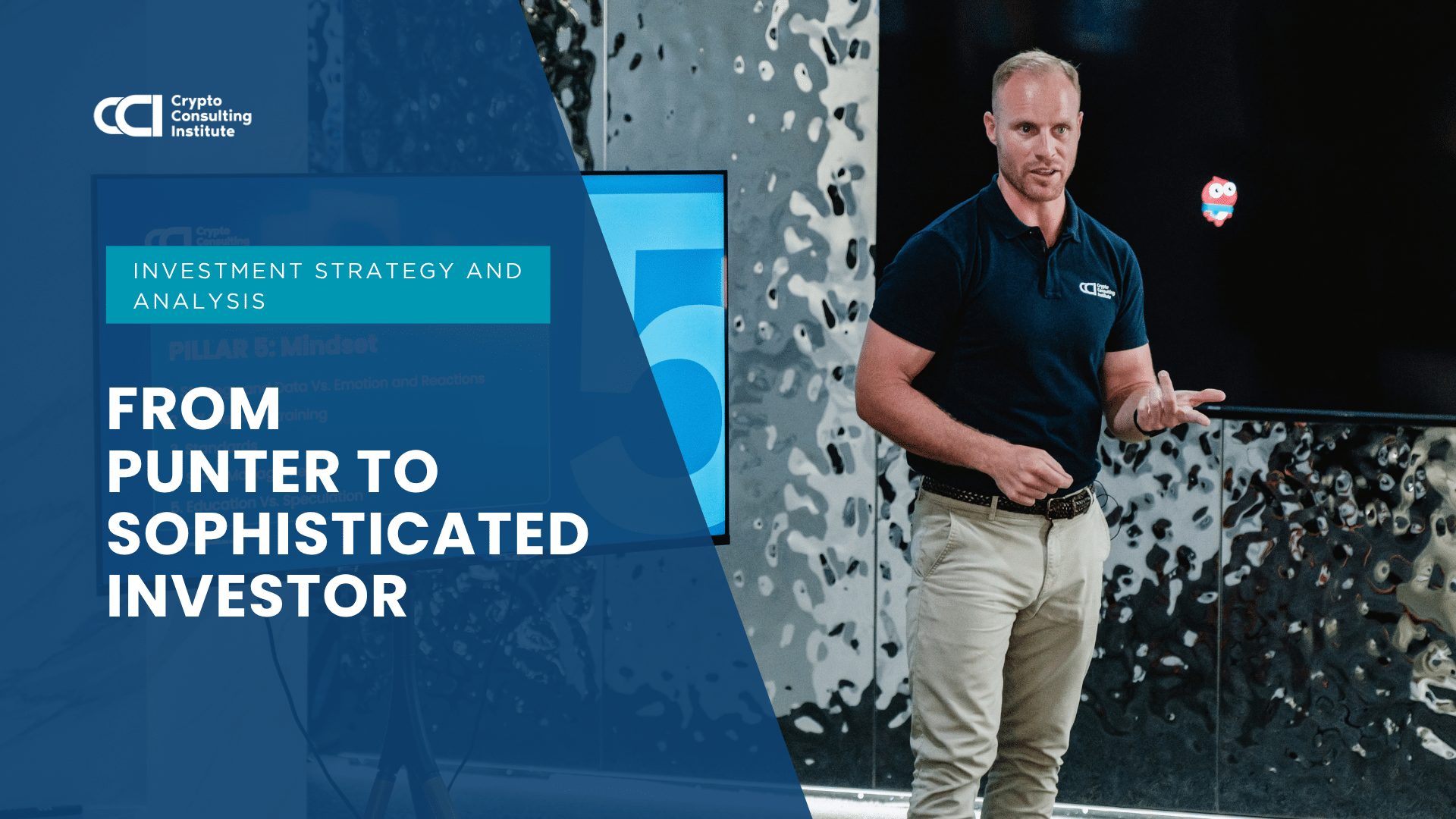
Most people do not arrive in crypto with a process. They arrive with a feeling.
They have seen the headlines. They have watched someone on YouTube explain why a particular coin is about to run. A mate at the barbecue did well. So they open an account, buy something, and spend the next 18 months on a rollercoaster: buying when it feels good, selling when it feels bad, and slowly realising that the education they are paying for is being charged to them in losses rather than fees.
We know this pattern well, because many of the people in our community lived it before they found us. Since 2016, over 3,000 clients have been through our programs, with $56 million in client-reported profits recorded to date. And the single most consistent difference we see between those who build real wealth and those who stay stuck is not intelligence, capital or luck. It is whether they have a process they trust.
That process is our 5 Pillar System. It is the foundation of everything we teach at CCI, and it has been refined over a decade of full market cycles. It is not complex. It is built for everyday investors with jobs, families and busy lives, who can give this around 20 minutes, 3 to 5 times a week.
This is the journey from punter to sophisticated investor. Here is how it works, and why the order matters.
The 5 mistakes that keep investors stuck
Before the framework, it helps to name what it is designed to fix. The mistakes we saw when we started CCI are the same ones we see today. The coins change. The behaviour does not.
1. Handing your financial future to uninformed voices.
This is the costliest one. Crypto attracts a flood of commentary from people who have never built wealth in any asset class and who are monetising attention, not results. Our own fundamental analyst publicly flagged the structural weakness in an algorithmically pegged stablecoin roughly 6 months before it collapsed, while much of the influencer world was still promoting it. The issue is not that these voices are always wrong. It is that you have no way of knowing when they are, because you are too far from the data to check.
2. Emotional investing
You roll out of bed, check your phone, see red, and sell. The next day it reverses. You buy back higher. It drops again. That is not a market problem. It is a standards problem, and it is exactly what Pillar 5 is built to address.
3. Treating the market like a casino
There is a reason casinos have no windows, free drinks and perfect air conditioning. The environment is designed to keep you playing until the statistics do their work. A lot of retail crypto activity looks exactly the same. Our view is simple: investing should be boring. If your week in the market feels thrilling, that is usually a sign of an absent process, not a good one.
4. Sitting on the sidelines.
The mirror image of gambling. Waiting for the perfect bottom, waiting for certainty, waiting for the right time. The right time never announces itself. There is only a position you have prepared for, or one you have not.
5. Choosing speculation over education.
If you are not informed, you are gambling. It is a confronting line, and we say it with care, because it is usually our families' hard-earned money on the table. It is also the honest truth, and it is the gap the 5 Pillar System exists to close.
Now let’s get into the proven formula




Pillar 1: Asset management
Almost nobody starts here. That is exactly why we do.
Asset management is about security, custody and control. It is the least glamorous part of investing, and the only part where a single mistake can undo everything else. When FTX collapsed, a great many people discovered that the crypto they thought they owned was never theirs. It was an entry in someone else's database. "Not your keys, not your crypto" is not a slogan. It is a plain description of reality that most people only test at the worst possible moment.
We think of it like the foundations of a house. Get the foundations right and you can build a house, or even a hotel, on top with confidence. Get them wrong and it does not matter how good the rest of your strategy is, because you are building on ground that can move.
This pillar covers self-custody and hardware wallet setup. It also covers the parts most people skip: backend management, backups, what happens when you travel, and what happens to your holdings if something happens to you. These questions can feel uncomfortable. Answering them is what turns uncertainty into confidence, and confidence is what allows you to invest with clarity rather than anxiety.
It also covers scam awareness. Crypto sits where money and technology meet, and that combination produces overwhelm. Overwhelm is exactly what scammers rely on. The text saying your account has been compromised. The unexpected device login from a city you have never visited. The email about a firmware update with a convenient link. The trading bot that promises to do the work for you. None of these are clever. They do not need to be. They only need to catch you in a rushed moment.
The rule we teach every client is simple: never act from the message. Go directly to the platform. If the update or issue is real, it will be there.
Pillar 2: Data-driven decisions
With your foundations secure, the next question is how you make decisions at all.
Most people decide on how they feel. Market up, feels safe, buy more. Market down, feels dangerous, sell. Emotion is a powerful driver for why you invest: your family, your vision, the life you want to build. It is a terrible driver for individual decisions.
Sophisticated investors replace feeling with data, drawn from 4 sources. Think of them as pieces of a puzzle. Hold only 1 piece and try to describe the whole picture, and you will be wrong. Often confidently wrong.
Macro context. Interest rates, global liquidity, geopolitical events and scheduled policy decisions. Much of what moves crypto is anticipated before it happens, as markets price in expectations ahead of the event. When you understand what is coming and how similar events have historically interacted with risk assets, you stop waking up to a red candle and wondering why.
Technical analysis. Genuinely valuable, and genuinely incomplete on its own. Patterns repeat often enough to be informative. They are one voice in the conversation, not the whole conversation.
On-chain data. This is the piece no other asset class offers. Think of a good mechanic who lifts the bonnet rather than guessing from the noise. Every transaction in the network's history is visible, and every transaction is a decision a real person made. That makes on-chain data behavioural data. Are long-term holders accumulating or distributing? Are short-term holders in profit or under water? You are not just reading price. You are reading what people actually did.
Psychology and sentiment. We call the simple version the taxi test. When your driver starts telling you about their portfolio, the crowd has arrived. When people tell you crypto is dead, the crowd has left. Sentiment at scale is driven by fear and euphoria, which means it is loudest precisely when it is least reliable. There are proper metrics behind this, but the taxi test makes the principle stick.
The aim of this pillar is not to turn you into a full-time analyst. It is to help you tell the difference between an informed position and a borrowed opinion. That clarity is where conviction comes from.
Pillar 3: Asset selection
Asset selection is where your risk profile meets market context. It is also where most portfolios go wrong in ways that stay invisible until they are not.
Two questions do most of the work.
The first is what kind of investor you really are. Not who you would like to be, and not what the market happens to be rewarding this month. A low risk tolerance paired with high-risk holdings is a recipe for panic selling, because the position was never one the person could emotionally hold.
The second is where we are in the cycle. This is the part punters miss. Risk tolerance is not a permission slip. A higher risk appetite does not make every asset appropriate at every stage, and an investor who is comfortable with volatility can still be badly positioned if they add speculative exposure when the wider market is stretched.
The discipline we teach is to measure your holdings honestly against a benchmark, not just against the dollar. A position can look flat or even positive in currency terms while quietly losing ground against the broader market. Measuring relative performance rather than headline price is a simple habit, and one of the fastest ways to see what your portfolio is really doing.
You will notice we are not naming coins here. That is deliberate. CCI is an education business, and any token-specific view we share comes from a named analyst on our team with the right context attached.
This pillar gives you the criteria, not a shopping list. People who are handed a list keep needing another one. People who are handed criteria become independent, and independence is the whole point.
Pillar 4: Investment strategy
Pillar 4 is where the first 3 pillars become a plan. And a plan is what finally lets you stop chasing the market.
A workable strategy starts with an honest look at your own situation. How much time can you genuinely give this each week? What is your real risk tolerance, not your aspirational one? Are you working on a short, medium or long-term horizon, or a blend of all 3? These are not philosophical questions. They shape everything that follows.
From there, the goal is to build a set of conditional responses: if this happens, I do that. Decided in advance, written down, and set up before the conditions arrive rather than in the heat of the moment. Across Bitcoin. Across relative strength. Across currency exposure, if you hold in one currency and think in another.
This is what we mean when we say let the market come to you. When your responses are prepared, market movement becomes information rather than an emergency. This has happened, so I do that. Now we are here, so I manage this. There should be very few surprises.
A good strategy is also results-based rather than belief-based. You should be able to test it against historical data and see how it behaved through different conditions. History is not a guarantee of what comes next, and we would never present it as one. But a framework you have tested is fundamentally different from one you have assumed. One survives a drawdown. The other gets abandoned in week 3.
Pillar 5: Mindset and standards
We save the most important pillar for last, because it decides whether the other 4 ever get used.
Put a Formula One driver in an ordinary car and they will get everything out of it. Put an ordinary driver in a Formula One car and the car makes very little difference. We all take ourselves with us. You can hand someone a complete, tested framework and watch them not follow it, because a system only performs as well as the person running it.
What holds most people back are stories. I have always been bad with money. I lost last time. I am not a numbers person. Those stories exist to keep us safe where we are, and they are very good at it.
What we build instead are standards: what you uphold when no one is watching. In practice that looks like: I do not check the market before 10am. I set my strategy once a week after the weekly close, not in reaction to a single candle. I never make a decision in the first minutes after waking. These are not restrictions. They simply remove the moments where bad decisions get made.
Think of the world's best tennis players. Their results on court are built off court: sleep, routine, preparation, focus, recovery. Investing is no different. Your mornings, your stress levels, your relationships and your health are not separate from your performance. They are inputs to it.
Underneath it all runs a simple chain. Belief shapes attitude. Attitude shapes how you feel. How you feel shapes what you do. What you do produces your result. If you decide in advance that this is too complex for you, that belief will prove itself, because you will never take the actions that could disprove it. If you decide you can learn a proven system, you take the action, and the path gets clearer as you walk it.
This is the least technical pillar. In our experience, it is also the one that changes lives.
From punter to sophisticated investor
Watch enough portfolios over enough cycles and 4 types of market participant emerge.
The constant watcher. High activity, endless screen time, thousands of trades a year, and returns that rarely justify the hours once they are honestly counted. Short timeframes are statistically unforgiving, and with proper position sizing, trading a modest portfolio intensively is a poor trade for your time and your life.
The hope investor. Running on tips, hunches and what a mate said. Results depend on luck, and luck depends on the cycle.
The sideliner. Avoids losses by avoiding participation, and pays for it in missed opportunity instead of capital.
The sophisticated investor. Patient, prepared and informed. Decisions made from data, not emotion. Positioned in advance, letting the market come to them. This is who the 5 Pillar System is designed to help you become, and it is who our community is made of.
None of this requires you to quit your job or become a full-time analyst. It asks for 5 things: a secure foundation, 4 sources of data instead of 1, honest asset selection, a tested plan, and the standards to follow it when it gets uncomfortable. That is the whole system. Crypto has real complexity, but it is rarely where people think it is, and it is almost never what stops them.
What stops most people is going it alone. The investors we see thrive are the ones who surround themselves with an informed, supportive community of people doing the work alongside them, rather than the noise of social media and hype. That is the environment we have spent a decade building, and it is why so many of our clients describe CCI less as a course and more as a family.
The cycles will keep turning. The opportunity is to meet the next one with clarity, discipline and conviction, and to safely create wealth that lasts for you and the people you love.